Comically Large

Context
Comically Large is a drawing game you play standing up, on a canvas projected onto the floor, holding a pencil about as tall as you are. It was the second half of my senior capstone. The first half was Rampage, which one person played sitting down at a controller we built by hand, and this one kept the part of that idea worth keeping: the controller is the joke, and the rest of the design follows from it.
Two players stand on the canvas and get one prompt between them, something like a wizard ordering coffee, and a minute to draw it together on either side of a dashed line down the middle. Three brush sizes each and one undo each. Nobody is any good at it, and being bad at it in front of a queue of strangers turns out to be the appeal.
Eight of us built it, four designers and four developers. Each pencil has a distance sensor in the tip that switches an infrared light on when the tip comes near the ground, an infrared camera above the floor watches for those lights, and a Python service reads the camera and hands the positions to the web app. The picture comes from two projectors rather than one, aimed so that a person standing on the canvas cannot black out the part of it they are drawing on. My half of the developer work was the game itself, the layer underneath it that turns a moving light into a pen, and everything that happens to a drawing after the clock runs out.
Details
- Role
- Developer
- Team
- Eight, four designers and four developers
- Timeline
- Jan — Apr 2026
- Built with
- JavaScript, Python, Arduino, Resolume
- Deliverables
- The game, the tracking bridge, the gallery and its printer
- Status
- Exhibited at Imagine RIT 2026
Final artifacts
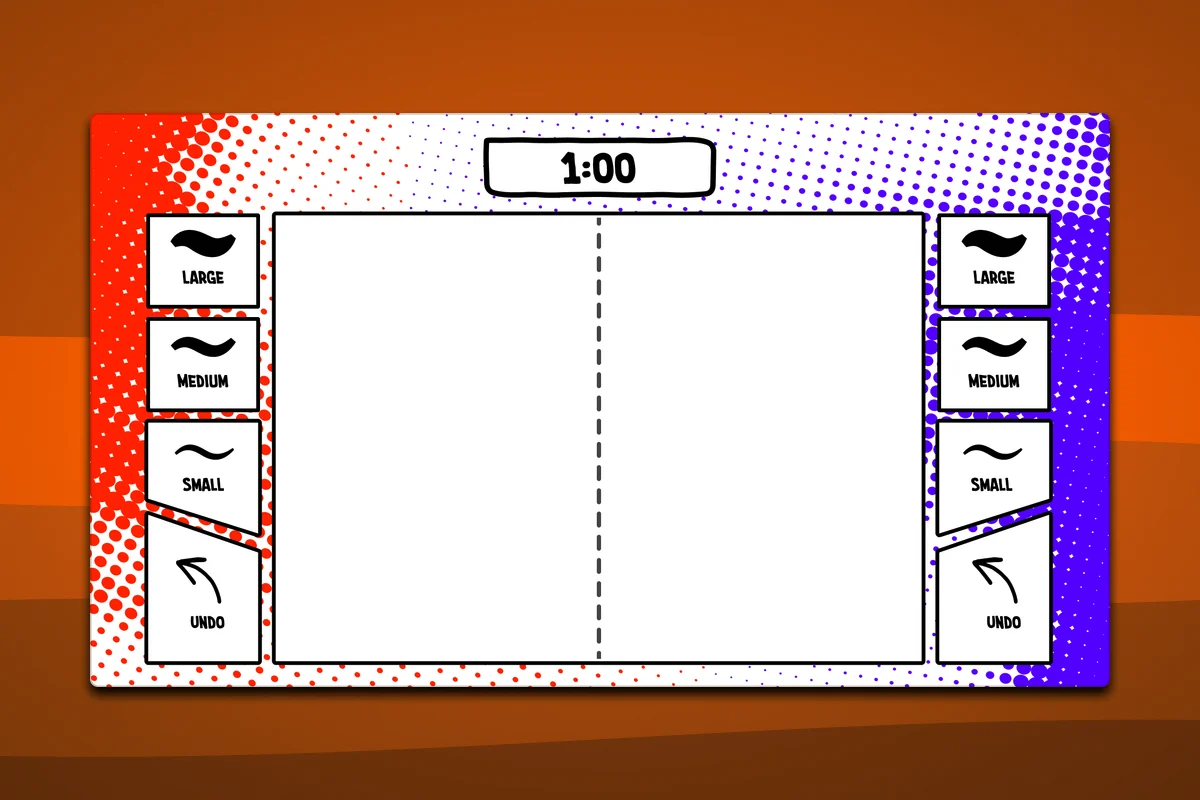
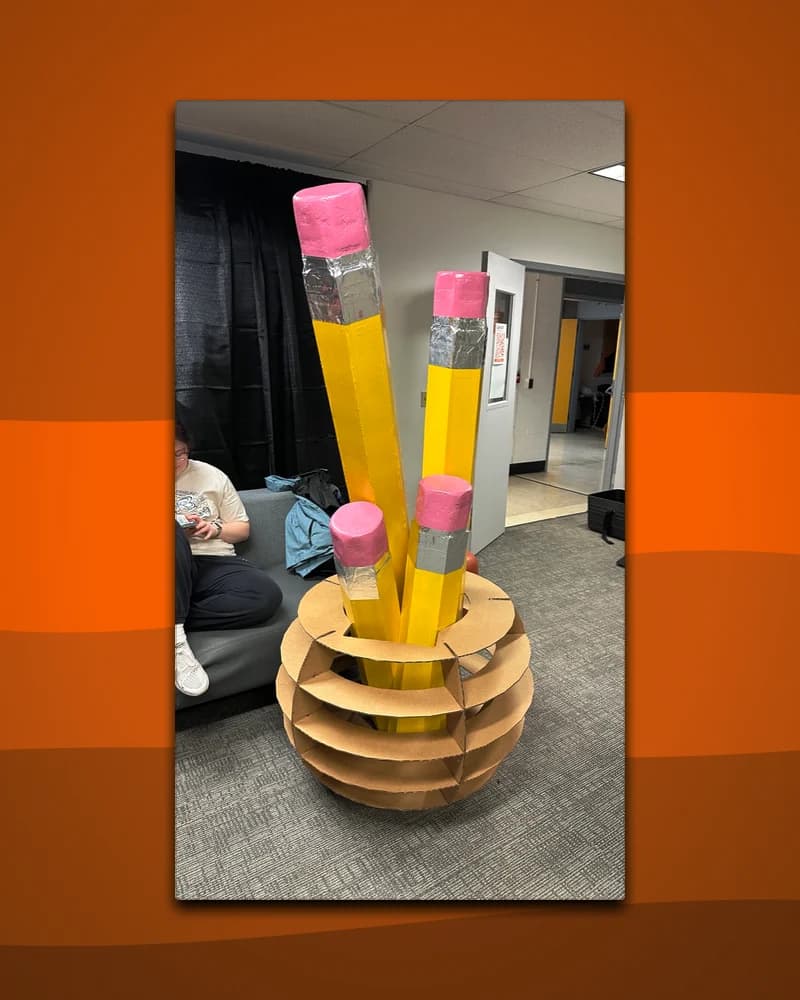
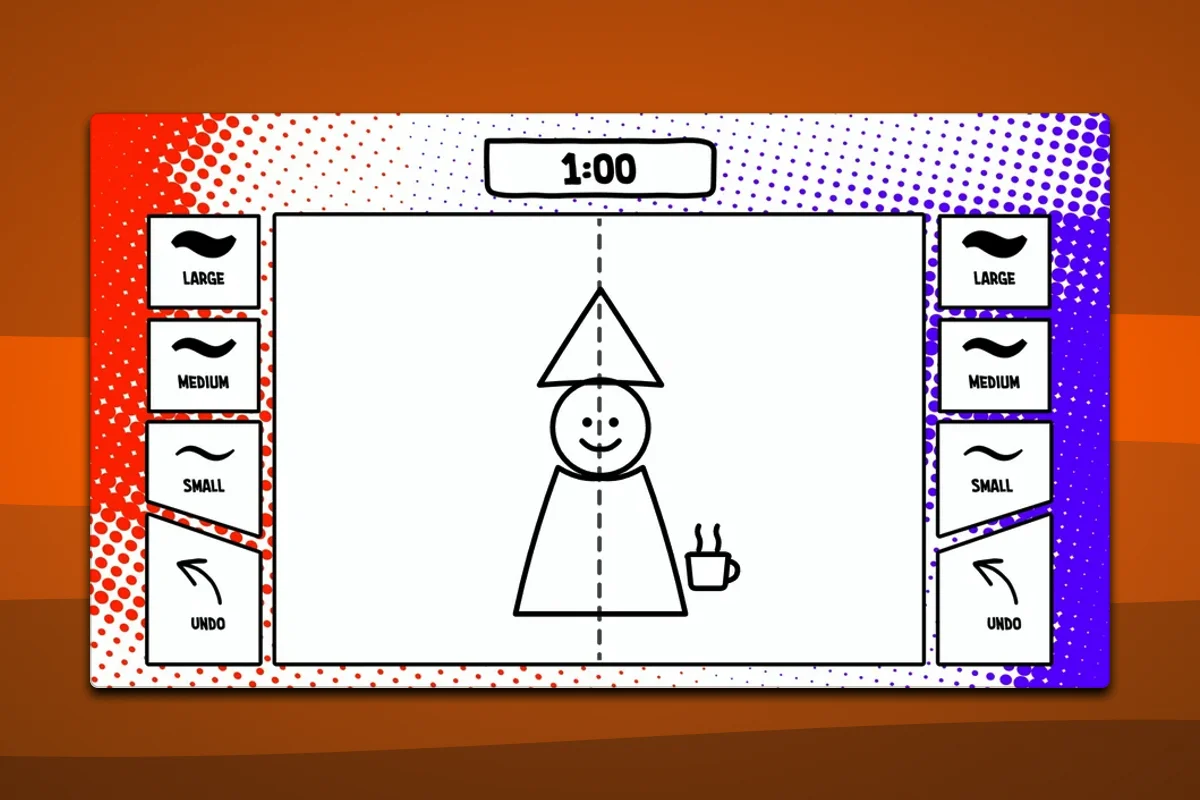
Key design moments
The camera saw lights and the game wanted a pen
The tracking ran in Python, the game ran in a browser, and I wrote the piece in between. Sending the camera's coordinates straight to the canvas gave lines that shook, because a light on the end of a pole held by a person is never still, and a projector shows you every bit of that at full size. Smoothing it fixes the shake and buys the opposite problem: enough smoothing to make a line look like a line adds enough delay that the mark stops feeling like it came out of your own hand. Most of what I did on that layer was moving back and forth between those two. The distance sensor in the tip is what made any of it work, because it gave the bridge a real answer to whether the pen was down instead of a guess made from how the light was moving. The picture is the prompt screen, which is the last calm thing that happens before all of that has to be right.
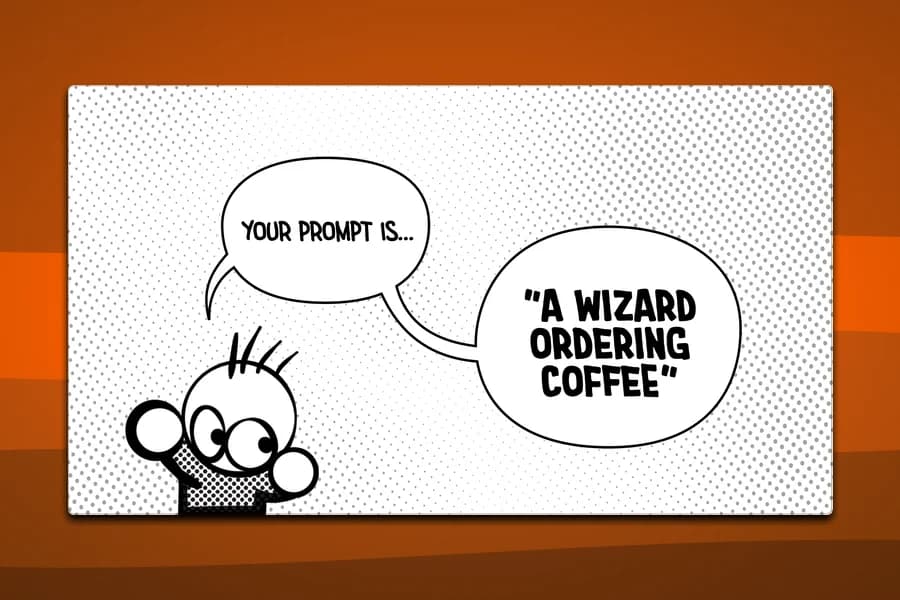
We had never run the whole thing at once until the morning of the show
We got to the room early on the day of Imagine RIT with hours in hand and used every one of them. The projectors would not hold their connections, and the tracking had to be re-aimed for a room nobody had calibrated in. Every part of it had been tested next to the other parts rather than wired to them, so the first time the camera, the game, the projectors and the printer all ran together was a few hours before the doors opened. It worked, and I have no interest in doing that again. Splitting eight people into four clean pieces is the fastest way to make progress right up to the moment the pieces have to be one thing, and we left that moment until it was hours away instead of weeks. The picture is from after all of that, once it was running and none of it was my problem any more.
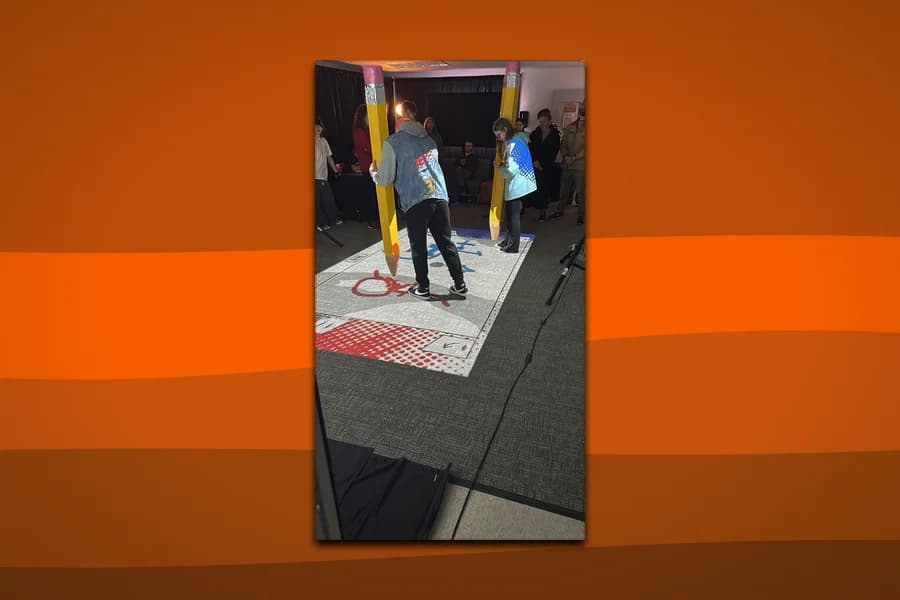
Every drawing left the room twice
When the clock hits zero the drawing is finished whether it is finished or not, and then it gets saved. I built that end of it. The canvas goes into a storage bucket with a row in Postgres beside it, a screen outside the room cycles through everything drawn that day so the queue has something to look at, and a small tool converts a drawing into something a thermal printer will accept, so two people who have just drawn something the size of the floor walk away holding it at the size of a receipt. That last part is the whole joke of the project and it is the only part of it anybody took home. The picture is Mic, the pencil headed character the designers drew for the game, who is also what was on the stickers.

Impact
More than 800 people picked up a pencil over the day at Imagine RIT, and we ran it again afterwards at the Interactive Media Symposium. The number I would defend hardest is not in the row above: it ran all day without anybody crouching over a laptop between players. A public installation has nobody to reset it and no patience to draw on, and that is not something you can find out about a build in a room with four developers in it. The other two figures only mean anything in person. There were three sizes of pencil on the floor and a thousand stickers of Mic to give away.
Reflections
Almost everything I had made before this was mine alone. Coursework is usually solo and at Korrit I work for myself, so eight people with four designers among them was new, and what surprised me was how much easier it made my own half. I have spent a lot of hours on personal projects deciding badly what a screen should look like. Here the look arrived as finished assets: a mascot, a halftone frame, a set of screens already drawn, a palette that was not up to me. I built to them. The half of the work I am worst at was done by people who are good at it, and I would take that trade on anything.
What I would change is the order. We split into four pieces early because that is the fastest way for eight people to make progress, and it was, and then each piece spent months being tested against a stand in for the next one rather than against the real thing. Finding out on the morning of an event what a camera and two projectors do to each other in a room you have never worked in is a bad way to find it out. If I ran it again I would spend the first month getting one end to end run working badly, all of it wired together and none of it good, before anybody was allowed to go and make their own part good.